Introduction
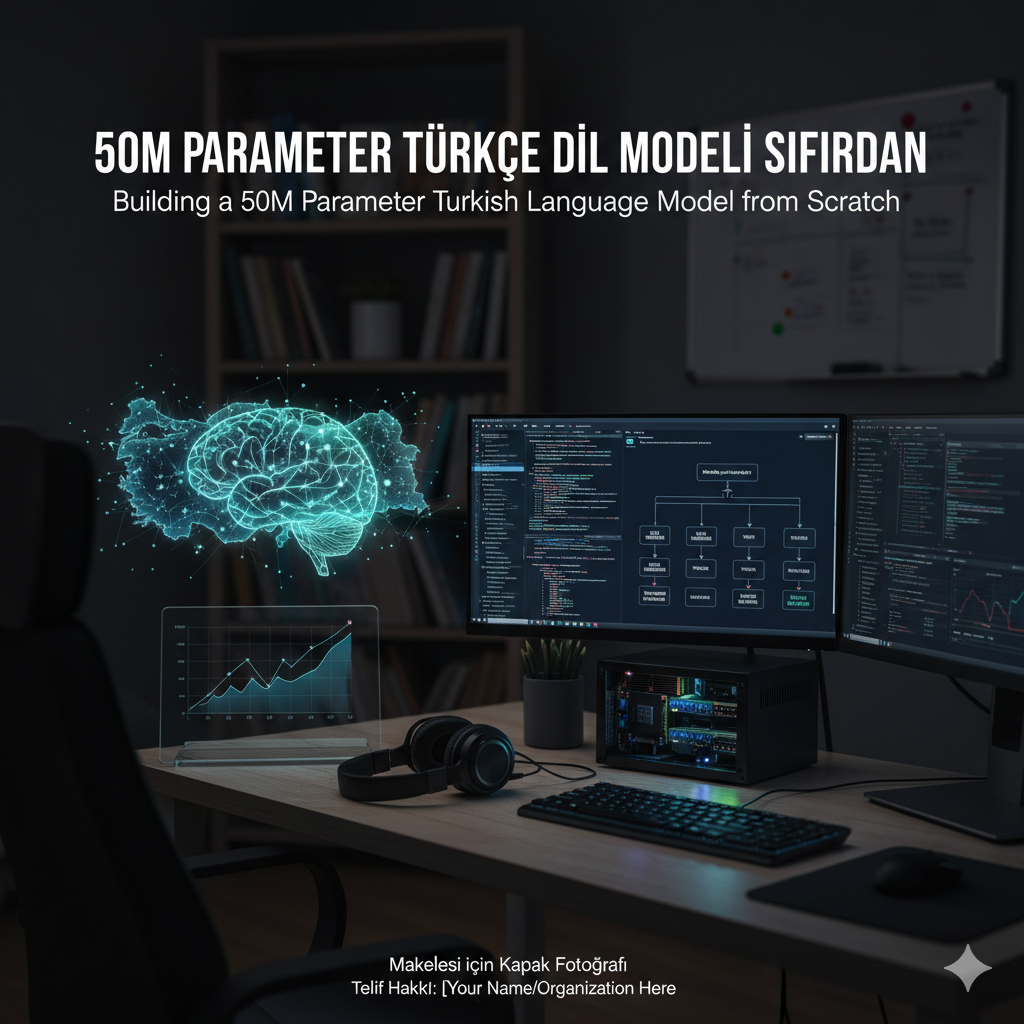
At DemirözAI, our vision is to develop artificial intelligence models trained entirely on clean, original Turkish data. Our goal is to create native AI solutions suitable for both individual and enterprise needs. As the first step in this journey, we successfully developed a 50 million parameter Turkish conversational model trained from scratch. This article details the model's training process, techniques employed, and future application areas.
Data Collection and Preparation
The foundation of our model's success lies in carefully curated Turkish datasets. We compiled and processed data from diverse sources to ensure comprehensive language coverage:
- Turkish Wikipedia: Encyclopedic, reliable content providing factual knowledge
- TS Corpus and National Turkish Corpus: Extensive written texts covering various domains
- OpenSubtitles: Conversational language structures from film subtitles
- Forums and Q&A logs: Natural conversation data reflecting everyday language use
All data underwent rigorous preprocessing: conversion to UTF-8 standard, removal of HTML/Wiki markup, and filtering of extremely short or irrelevant sentences. This resulted in a completely Turkish, consistent, and clean training dataset.
Tokenizer Development
To enable the model to process Turkish text effectively, we trained a specialized Byte-Level BPE Tokenizer. This tokenizer encompasses approximately 50,000 subword units and is optimized for Turkish's agglutinative structure. The tokenizer enables the model to better understand Turkish morphology and generate fluent sentences.
Model Architecture
Our model is a 50 million parameter language model inspired by the GPT-2 architecture. The configuration is as follows:
- Number of layers: 6
- Hidden dimension (embedding size): 512
- Multi-head attention: 8 heads
- Context window: 1024 tokens
This architecture enables the model to learn Turkish grammar effectively and generate fluent text in short to medium-length contexts.
Training Process
Training was conducted on an NVIDIA RTX 3050 Ti GPU using the Hugging Face Transformers library. We employed several optimization techniques to maximize efficiency:
- Mixed Precision (FP16): Reducing memory usage and increasing training speed
- Gradient Accumulation: Compensating for small batch sizes for efficient training
- LoRA (Low-Rank Adaptation): Providing parameter efficiency during fine-tuning
- Bitsandbytes 8-bit optimizers: Fast optimization with lower memory consumption
| Training Phase | Token Count | Duration |
|---|---|---|
| Pre-training | 50M tokens | 10-20 hours |
| Fine-tuning | 20M tokens | 4-8 hours |
| RAG Integration | 5M tokens | 1-2 hours |
Total training time was completed in approximately 1-2 days, demonstrating that effective language models can be developed even with limited computational resources.
Retrieval-Augmented Generation (RAG)
Beyond basic language knowledge, the model is enhanced with RAG (Retrieval-Augmented Generation) for current or domain-specific information. Our implementation includes:
- Documents stored in a CPU-based vector database (FAISS, Milvus)
- Relevant document retrieval based on user queries
- Context injection for more accurate response generation
RAG enables the model to access information beyond its training data, significantly improving accuracy without requiring retraining.
Performance and Use Cases
While a 50M parameter model has limited capacity compared to large-scale models, it performs effectively in several key areas:
| Application Area | Performance Level |
|---|---|
| Simple Conversation | High - Fluent dialogue flow and sentence completion |
| Domain-Specific Content | Good - Effective for specific topics with fine-tuning |
| Language Tools | Good - Spell checking, synonym suggestions |
| Q&A Systems | Good - RAG-enhanced knowledge-based responses |
Technical Optimizations
Training on consumer-grade hardware required careful optimization strategies:
Memory Management
With only 4-6GB VRAM available on the RTX 3050 Ti, we implemented aggressive memory optimization:
Parameter-Efficient Fine-Tuning
LoRA adaptation allowed us to fine-tune the model with minimal additional parameters:
- Only low-rank matrices are trained during fine-tuning
- Original model weights remain frozen
- Dramatically reduces memory requirements
- Maintains performance comparable to full fine-tuning
Future Roadmap
As DemirözAI, our goal is to develop larger and more powerful Turkish AI models building upon this foundation. Our near-term plans include:
- 100M+ parameter models: Scaling up for improved performance
- Domain-specific chatbots: Specialized models for law, healthcare, and education
- Enterprise RAG solutions: Custom knowledge bases for organizations
- Multi-modal capabilities: Integrating vision and speech understanding
Lessons Learned
Through this project, we gained valuable insights into developing language models for morphologically rich languages:
- Tokenization is crucial: A well-designed tokenizer specifically for Turkish significantly improves model performance
- Hardware limitations drive innovation: Constraints forced us to adopt cutting-edge optimization techniques
- RAG is game-changing: Augmenting small models with retrieval dramatically expands their capabilities
- Community datasets are valuable: Open-source Turkish corpora provided an excellent foundation
Conclusion
This Turkish conversational model developed from scratch by DemirözAI represents a significant step forward for native AI research. The model, developed with clean data, modern training techniques, and RAG integration, paves the way for AI solutions optimized for Turkish.
Despite the constraints of consumer-grade hardware and a relatively small parameter count, we've demonstrated that effective language models can be built for specific languages and use cases. Our experience shows that with the right techniques and optimizations, meaningful AI development is accessible even without massive computational resources.
This project serves as both a proof of concept and a foundation for future work in Turkish language AI. We believe that language-specific models, trained on high-quality native data, will play a crucial role in making AI technology more accessible and effective for Turkish speakers worldwide.