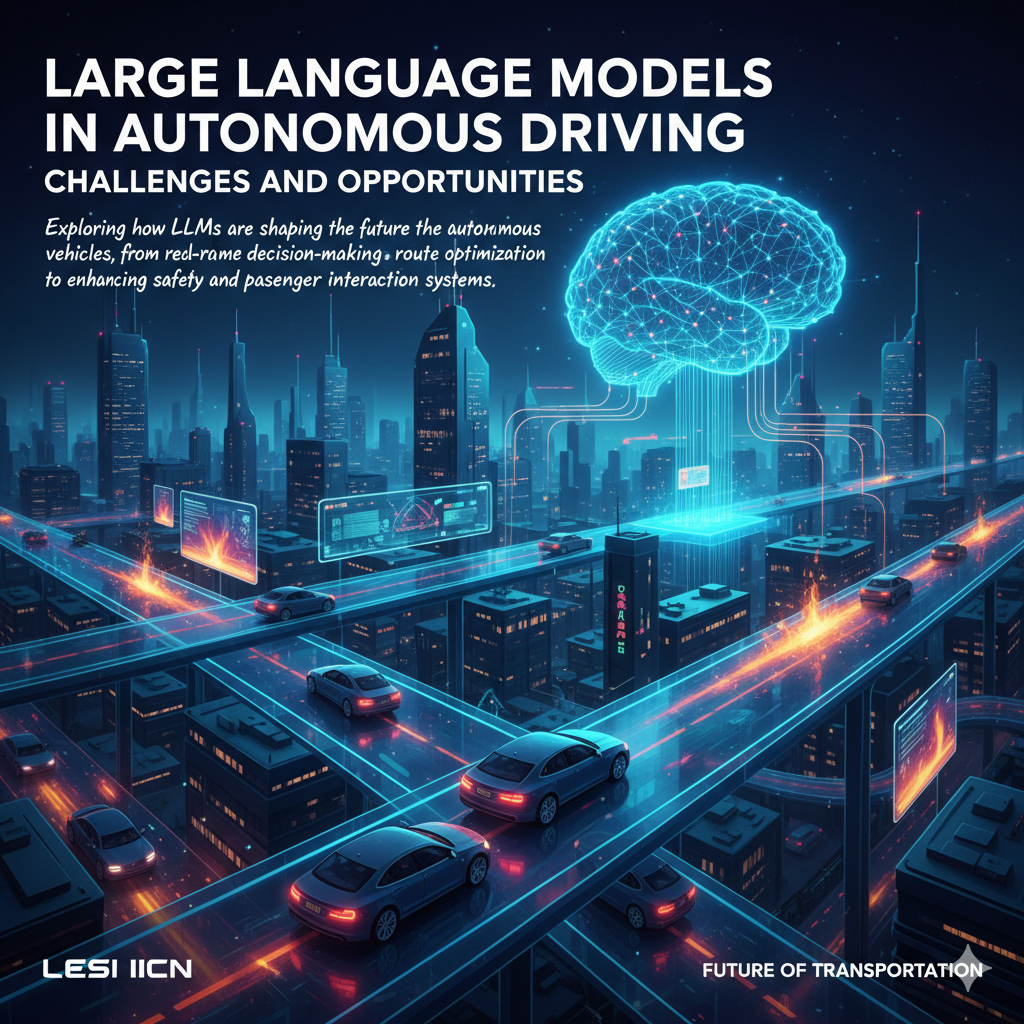
Self-driving cars are no longer science fiction, and the latest leap comes from advances in large language models (LLMs) – the same kind of AI that powers chatbots like ChatGPT. By blending language AI with vision and sensor data, carmakers and tech companies are giving autonomous vehicles a kind of "brain" that can reason in real time, plan smarter routes, chat with passengers, and spot hidden hazards.
Real-Time Decision-Making on the Road
Autonomous cars must decide instantly how to react to everything they "see" – other cars, pedestrians, traffic lights and more. Traditionally, rules-based software or neural nets handle this. Now, engineers are adding LLM-powered reasoning on top.
Leading Industry Applications
In tests, Nuro's LAMBDA could tell the difference if an oncoming car was slowing to let the robot-car pass, or if a pedestrian was just jogging by. That extra insight helps the car decide whether to brake or go. Other teams fuse vision and language AI so the car can answer questions about its surroundings.
Smarter Navigation and Route Planning
Language AI can also make navigation smoother and more flexible. Today's self-driving systems already use detailed maps and traffic data, but LLMs can add a conversational layer. Imagine telling the car, "Take the scenic route to work, avoiding highways," and having it understand and plan that complex request.
TomTom & Microsoft Partnership
Navigation specialists TomTom (Netherlands) and Microsoft built a new in-car assistant that lets drivers ask multiple questions in one command. You can say "navigate to downtown but find a gas station on the way," and the AI will update the route accordingly.
Advanced Navigation Features:
- Natural route queries: The AI can digest requests like "avoid tolls" or "shortest path with traffic" and recalculate accordingly
- Multi-stop optimization: By "talking" to its map data, an LLM could plan the best order to run errands or drop off passengers
- Real-time updates: If an accident or jam appears, the system can quickly reroute using both map knowledge and common-sense reasoning
- Contextual suggestions: Cars can suggest rest stops, dining options, or points of interest based on natural conversation
Conversational AI for Drivers and Passengers
One of the most visible changes will be talking to your car like a helpful co-pilot. Voice assistants in cars used to be fairly limited – you could say "play music" or "what's the weather" – but now they're becoming full-blown chat partners.
Mercedes-Benz "Hey Mercedes"
Mercedes-Benz now uses ChatGPT technology so drivers can talk naturally with the car. For example, asking "Hey Mercedes, how do I park this model?" will get a helpful explanation without digging through manuals. Over 900,000 U.S. cars are already testing the ChatGPT-powered assistant.
BMW & Amazon Collaboration
BMW teamed up with Amazon to demo a new voice AI that combines Alexa with LLM technology. At CES 2024, BMW showed it off answering technical questions and even recommending and activating drive modes based on location.
What You Can Do with Conversational AI:
- Control features by voice: "Set the cabin to 70°F and play jazz," or "Find us a coffee shop 5 miles ahead"
- Learn about the car: "How do I open the sunroof?" or "Switch to eco mode," with the AI explaining and executing commands
- Ask anything safely: Passengers can ask general questions about maps, trivia, or recommendations without distracting the driver
- Natural conversation flow: Carry on extended dialogues about destinations, preferences, and vehicle functions
Boosting Safety with AI Insight
The ultimate promise of LLMs in self-driving is safety. By giving cars a little "common sense," they can spot hazards that rule-based systems might miss.
Kodiak Robotics Safety Innovation
Kodiak Robotics reports using vision-language models to improve hazard detection in their self-driving trucks. Their AI can literally "think" about what it sees. In tests, the truck's camera feed combined with language queries lets it recognize unusual situations that traditional sensors might miss.
Edge Cases and Novel Situations
These language-aided systems shine at "edge cases" – the weird, one-off things. The Kodiak team says their model identified roadside fire/smoke scenarios and obstacles like branches without ever explicitly training on them. By grounding vision in words, the AI recognizes that "this looks like a fire" or "these branches mean a road block."
Key Safety Improvements:
- Spotting rare hazards: Flag unexpected events like emergency vehicles, debris, or unusual road conditions
- Understanding context: Know what things mean beyond raw pixels and explain decision-making processes
- Generalizing to new situations: Handle never-before-seen scenes by reasoning based on language concepts
- Detecting sensor issues: Recognize when cameras are obscured or malfunctioning and act cautiously
Future Outlook: Balancing Innovation and Safety
Hybrid System Architectures
The future likely lies in sophisticated hybrid systems that strategically combine traditional deterministic algorithms with LLM capabilities. These architectures would leverage LLMs for high-level planning, contextual understanding, and user interaction while maintaining proven algorithms for safety-critical real-time control functions.
Industry Collaboration and Standards
Major partnerships like Volkswagen/Cerence and Microsoft/TomTom demonstrate the industry's commitment to LLM integration. However, success requires unprecedented collaboration between automotive manufacturers, AI researchers, regulatory bodies, and safety organizations to establish new standards and validation frameworks.
Key Development Areas:
- Edge Computing Advancement: Specialized hardware enabling sophisticated LLMs to run locally in vehicles
- Regulatory Framework Evolution: New testing standards and certification processes for AI-driven systems
- Federated Learning: Privacy-preserving approaches for sharing knowledge across vehicle fleets
- Explainable AI: Transparent decision-making processes for regulatory compliance and user trust
Conclusion: Navigating the Road Ahead
The integration of Large Language Models into autonomous driving systems represents both the greatest opportunity and the most significant challenge in modern automotive AI. While LLMs offer unprecedented capabilities for contextual understanding, natural interaction, and adaptive reasoning, they also introduce new complexities around safety validation, regulatory compliance, and system reliability.
Success will require careful engineering approaches that harness LLM strengths while mitigating their limitations through hybrid architectures, robust validation frameworks, and comprehensive safety systems. The companies leading this transformation – from Nuro's behavioral understanding to Mercedes-Benz's conversational interfaces to Kodiak's safety reasoning – demonstrate that this technology is already moving from research labs to real roads.
As this technology continues to mature, the automotive industry must balance innovation speed with safety rigor, ensuring that the promise of intelligent, conversational, and contextually aware vehicles is realized without compromising the fundamental safety principles that underpin public trust in autonomous transportation systems.