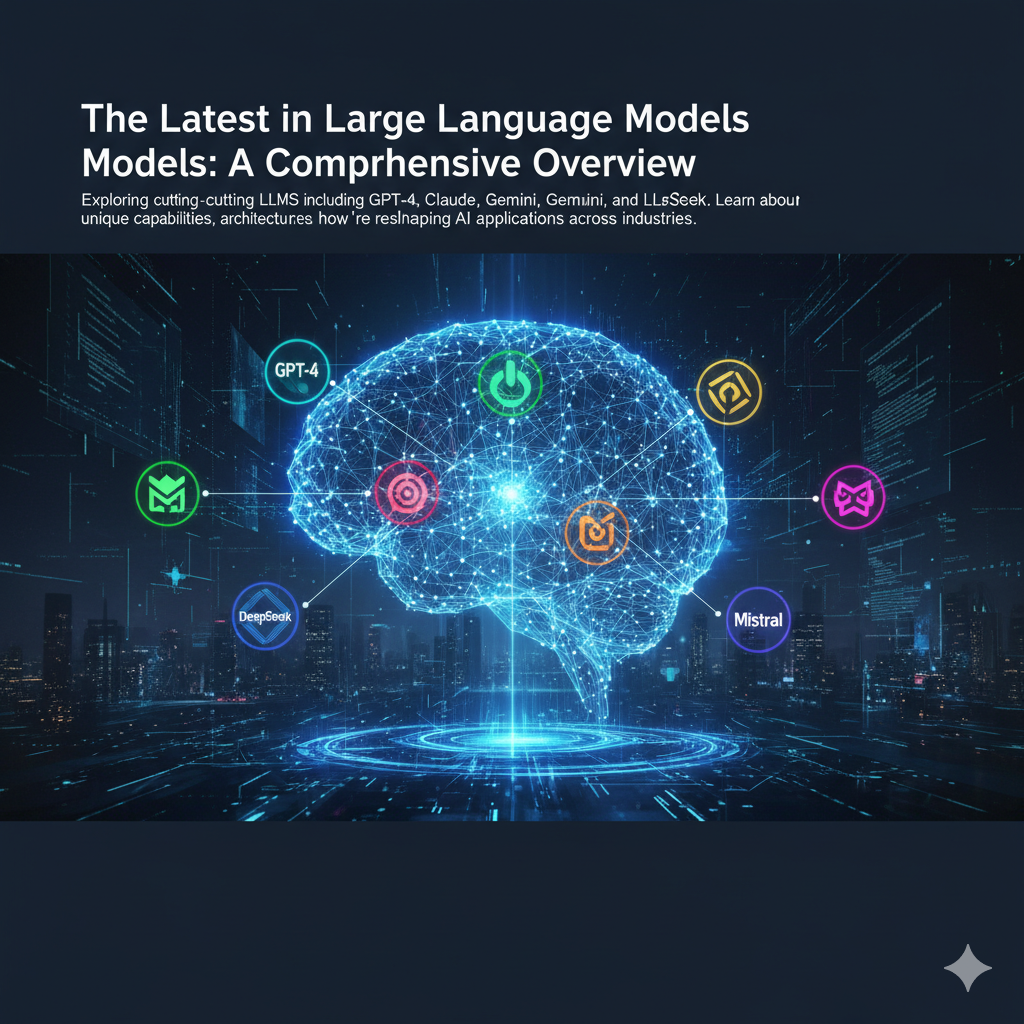
The landscape of large language models is evolving rapidly, with major breakthroughs emerging from leading AI research organizations. Let's explore the cutting-edge models that are reshaping artificial intelligence.
Introduction: The LLM Revolution
Large Language Models have transformed from experimental research projects into practical tools that power countless applications. From conversational AI to code generation, creative writing to scientific research, these models are becoming integral to how we interact with technology.
Current Generation Leaders
OpenAI's GPT Family
OpenAI continues to lead with their GPT series, featuring GPT-4 Turbo and the latest iterations that demonstrate remarkable reasoning capabilities across diverse domains.
Anthropic's Claude Series
Claude models, including Claude 3 Opus, Sonnet, and Haiku, are designed with a focus on safety and helpful interactions, featuring advanced reasoning and analysis capabilities.
Google's Gemini
Google's Gemini family represents a new approach to multimodal AI, capable of processing text, images, and code with impressive integration across Google's ecosystem.
Leading Models Comparison
Emerging Competitors
Meta's LLaMA 2 & Code Llama
Meta's open-source approach with LLaMA 2 has democratized access to powerful language models, while Code Llama specializes in programming tasks with exceptional performance.
Mistral AI Models
The French AI company has made significant strides with efficient models that deliver strong performance while requiring fewer computational resources.
DeepSeek and Chinese Innovation
DeepSeek models demonstrate that innovation in LLMs is truly global, with impressive capabilities in reasoning and code generation.
xAI's Grok
Elon Musk's xAI introduces Grok with real-time information access and a distinctive approach to AI interaction.
| Model | Context Window | Key Strength | Availability |
|---|---|---|---|
| GPT-4 Turbo | 128k tokens | General reasoning | OpenAI API |
| Claude 3 Opus | 200k tokens | Analysis & safety | Anthropic |
| Gemini Ultra | 1M tokens | Multimodal | |
| LLaMA 2-70B | 4k tokens | Open source | Meta |
| Mistral Large | 32k tokens | Efficiency | Mistral AI |
Technical Innovations
Architecture Advances
- Mixture of Experts (MoE): Models like GPT-4 use sparse architectures for improved efficiency
- Retrieval Augmented Generation: Integration of external knowledge bases
- Multimodal Integration: Seamless processing of text, images, and audio
- Extended Context Windows: Processing much longer documents and conversations
Training Innovations
Recent advances in training techniques include constitutional AI (Anthropic), reinforcement learning from human feedback (RLHF), and novel alignment approaches that make models more helpful and safer.
Applications and Use Cases
Professional Applications
- Content creation and copywriting
- Code generation and debugging
- Research assistance and data analysis
- Legal document review and analysis
- Educational tutoring and explanation
Creative Applications
- Story writing and worldbuilding
- Poetry and creative writing
- Brainstorming and ideation
- Game narrative development
Future Trends
Specialization vs. Generalization
We're seeing a bifurcation in the LLM space: highly capable general-purpose models alongside specialized models optimized for specific domains like medicine, law, or programming.
Efficiency and Accessibility
Future developments focus on making powerful models more efficient, enabling deployment on consumer hardware while maintaining high performance.
Multimodal Integration
The next wave will seamlessly integrate text, voice, images, and video, creating truly multimodal AI assistants.
Conclusion
The large language model landscape is more diverse and capable than ever. While GPT-4, Claude 3, and Gemini lead in different aspects, emerging models from various organizations continue to push boundaries.
The choice of model increasingly depends on specific use cases: GPT-4 for general reasoning, Claude for analysis and safety, Gemini for multimodal tasks, and open-source alternatives for customization and local deployment.